Showing posts sorted by relevance for query star wars. Sort by date Show all posts

Tuesday, March 27, 2012

Star Wars: Jedi Academy

It seems like almost every kiddo who walks into my library likes Star Wars. Our Star Wars books are always shelved on a special display, and it's a rare day we have more than five or six checked in for perusal. I'm always overhearing discussions about the films or tv show, and one fervent fan recommended I listen to the Star Wars Radio Drama that was on NPR a while back. These kiddos love Star Wars. So, this spring break, we gave them a Star Wars program.

My library's Star Wars: Jedi Academy program was born of an article in the September 2011 issue of ALSConnect (now ALSC Matters!)--it gives tons of ideas for games and other activities to make any library's Star Wars program absolutely stellar. Using the rubric described there, we fleshed out our program to make it interesting to as many kiddos as possible.

Star Wars: Jedi Academy was a carnival-style program. It was advertised on our program calendar as an hour-long event for all ages, but we made sure to tell folks who registered that they could come and go as they pleased during that time frame. The program description invited young Jedis to come practice and perfect their Jedi skills through a variety of activities and stations. Our final program set-up included nine distinct areas:

1. The Cantina -- We had small snacks available since the program took place at afternoon snack time. We used awesome cupcake stencils from Williams-Sonoma to decorate some of the platters of cookies.
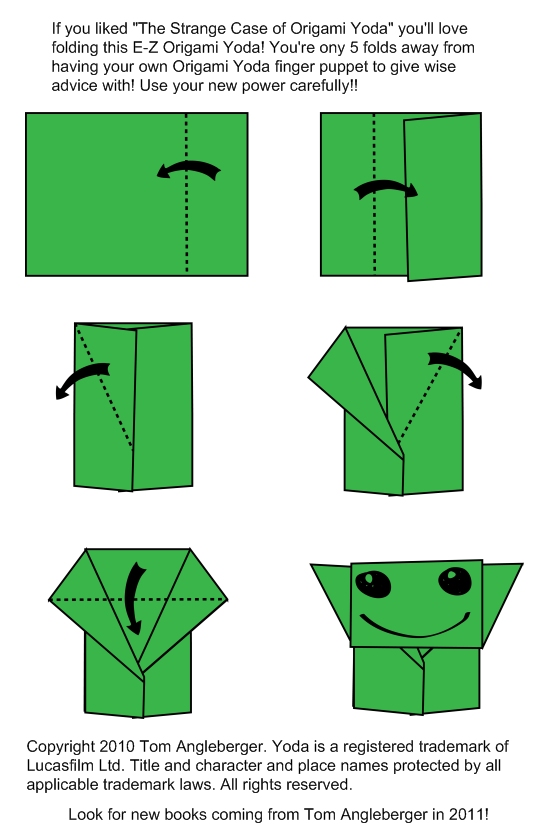
2. Origami Yoda Table -- We had instructions on hand as well as lots of bright green cardstock and markers for drawing faces.
3. Coloring Table -- I printed off some big coloring pages I found by browsing online. Most popular were Chewbacca, Darth Vader, and R2-D2. (I was particularly proud of the sign I made for this station!)
4. Jedi Library -- Every Star Wars book, DVD, and CD in my library that was available for check-out at the time of the program made it onto the shelves of the Jedi Library. By the end of the program, nothing was left.
5. Droid Toss -- I spray-painted and decorated some dollar-store trash bins to look as much like droids as possible, and kiddos tried to toss balls into as many as they could in four tries (a la Bozo Buckets).
6. Garbage Compactor Dive -- An old deliveries box was decorated with the labeling of the garbage compactor in Episode IV, and it was filled with dollar-store party favor prizes and lots of shredded paper that we saved from the recycle bin. Each young Jedi was blindfolded, spun around a few times, and then entreated to use the Force to find a prize amidst all the "trash."
7. Laser Blaster Target Practice -- A co-worker laminated some images of notorious Star Wars bad guys, and they were stuck to a window on our program room wall. Kiddos used Nerf guns with suction ammo to practice their blaster skills.
8. Lightsaber Practice -- Young Jedis were pitted against one another as they attempted to keep a balloon afloat as long as possible using only a lightsaber.
9. Jedi Archives Trivia -- A very enthusiastic and knowledgeable teen volunteer created easy, medium, and difficult trivia to test the knowledge of young Jedis in attendance.

The last five stations, all games, were staffed by either library children's staff or teen volunteers. Each of those stations involved a prize--a piece of candy, a Lego Star Wars sticker, a paper Star Wars character medallion, or the prize from the garbage compactor.

Our program was also lucky enough to have some costumed visitors on hand. I had put in an appearance request with the 501st Legion, and we ended up with two Stormtroopers, one Clone Trooper, and one Jedi Master in attendance throughout the program. Lots of the kiddos had attended in costumes of their own, but the looks of awe and excitement upon seeing "real" Imperial Soldiers and a Jedi Master were absolutely wonderful. These guys were incredibly professional and friendly, too, posing for tons of pictures with kiddos and taking it in stride when a Nerf dart inevitably became stuck to one of their costumes.
As excited as I was about offering the Star Wars: Jedi Academy program during spring break, I could not have anticipated just how popular it ultimately was. We had 170 people attend during the course of the hour-long event--parents mentioned that they had a hard time finding parking spots in our lot! Attendees were largely school-age with a handful of equally-excited preschoolers and teens (as well as some parents who were thrilled to share Star Wars with their kids in a new way!).

So many kiddos were beyond enthusiastic, and they've already been asking when the library will offer the program again. With all of the game supplies and decorations we have packed away in our storage room, I can happily say we'll have another Jedi Academy somewhere down the road.

Give this or a similar Star Wars program a try at your library, and may the Force be with you.

Wednesday, March 27, 2013

Star Wars Day: Spring Break 2013

A great Ahsoka costume.
My library just hosted our second annual Star Wars Day during our local school district's spring break. I worked with co-workers and teen volunteers to offer a variation on the Jedi Academy program we had last year, and after small bursts of program prep over the last two weeks, I can say that our program was just as much of a hit this time around. Our final count was 216 attendees, plus 5 teen volunteers and 4 staff helping in shifts. Here's what we did:

1. Costume Crafts -- Kids were encouraged to show up in costume, but I wanted everyone to have the opportunity to dress festively regardless of what they have at home. I drew templates for two costume headbands: Leia buns and Yoda ears. I printed the templates onto construction paper, and kids could cut and staple to create the costume they wanted.

The craft stations

2. Droid Toss -- This game was a repeat from last year--so many kids don't know what Bozo Buckets was, so they're intrigued by this "new" game. Kids tossed soft balls (meant for pool play) into a series of small trash cans decorated like droids; their reward for their effort was a piece of candy.

3. Star Destroyer Navigation -- I put up instructions for a simple paper airplane, which does already resemble a Star Destroyer in shape. Once they had constructed their Star Destroyers, kids tried to navigate their ships through warp speed--hula hoops suspended from the ceiling. Lots of fun, plus kids could take home their Star Destroyers.

4. Lightsaber Station -- I expanded on last year's Lightsaber Practice station, wherein young Jedis tried to keep balloons afloat as long as possible using a lightsaber. This time they made their own lightsabers, using a cut out hilt template on white cardstock and a piece of rolled-up neon cardstock for the blade. After creating their own lightsabers, which they could take home, kids tried to balance the balloons.

5. Destroy the Death Star! -- It takes precision with a laser gun to shoot down the Death Star, as we all learned in Episode IV. I made a posterboard Death Star, affixed it to a cardboard box, and cut a 4"x4" hole in the setup; kids then stood behind a masking tape line with a "laser blaster" (Nerf gun) and attempted to make the Death Star-destroying shot. The reward, aside from blowing-up noises from me, was a piece of candy.


6. Jedi Library -- I put out Star Wars books we had on the premises as well as several copies of everything from the Origami Yoda universe. The Jedi Library also boasted instructions for folding Origami Yoda, a template for making a Fortune Wookiee, a life-size cut-out of Darth Vader, and some great Star Wars READ posters from ALA. Lots of books checked out.

7. Jedi Archives Trivia -- I recycled the trivia questions a volunteer made for us last year. This time our trivia station was located at the reference desk--an attempt to keep people circulating throughout the library during the event. The very accommodating adult reference staff asked the young Jedi questions (easy, medium, or hard), for which they were rewarded with their choice of Star Wars sticker.

Three of the 501st posed with kids in their Yoda ears.
8. Imperial Photo Ops -- I feel lucky to have local members of the 501st Legion who are available to attend my Star Wars programs. Their in-universe costumes are meticulous, and there's nothing quite like a young Star Wars fan getting to see a full-size, "real" Storm Trooper. Any library (or other group, for that matter) can submit a request for an appearance on their website; the more notice you give them, the better the chance they can attend. We had 4 costumed members of the 501st at our program this year, and they spent their time posing for photos with the kids, walking the library, and trying some of the activities. (We had cookies and lemonade for them in a staff area for when they wanted a break.)

We made a few substantial modifications to the program itinerary this time around. First, we spread the program over 3 hours instead of scrunching it all into one; we advertised the program as come-anytime-during-the-event in the hopes that our large number of attendees would be spread out (as opposed to the 170 people in our relatively small room in one hour last year). This switch was definitely successful--we had a bunch of people in the first hour, then a slower period in the middle, followed by a second influx of families in the after-work 5-6 p.m. hour.

Second, to provide kids more bang for their buck, we added more multi-step craft components--to engage kids longer and more meaningfully. We still offered a number of carnival-style games, but the juxtaposition with longer hands-on activities expanded everyone's Star Wars Day experience while providing them with cool take-homes.

I highly encourage any and all libraries to offer some sort of Star Wars-themed event/craft station/etc. The kids love it, the parents and caregivers get really into it, and there are plenty of opportunities to be part of a larger library celebration throughout the year. There's May the 4th Be With You coming up, then Star Wars Reads Day in October. Make plans--these are the library programs you've been looking for.


Sunday, October 4, 2015

Star Wars Sticky Note Mosaic Murals

We celebrated Star Wars at my library this weekend. It was my first time being immediately involved in a big Star Wars program since my spring break programs in my former job, and while my current library has celebrated Star Wars for a few years now, the goal is to always add some new elements to the festivities. Of course we had some of the expected: trivia; a light saber craft; and a seek-and-find scavenger hunt. We also repeated using the green screen in our youth Digital Media Lab to take family photos and insert them into Star Wars backgrounds.

What was totally new this year, however, was the main activity taking place in the BOOMbox, our STEAM space: Sticky Note Mosaic Murals.

My colleague Amy Holcomb, who runs the BOOMbox, emailed me a few weeks back with a news article about a paper company, Viking Direct, that created such murals on their office walls. I looked at those pictures (and looked harder), and from there I created a 25-by-25 sticky note grid template in Excel, on which I designed Darth Vader and Yoda images. The individual grid templates are pictured below if you're interested.


To make this activity work, one of my program assistants broke each 25-by-25 mural into 5-by-5 squares; these squares each had a designated spot on a grid, allowing a child/teen to take one grid square "map," gather their requisite sticky notes, and place their sticky note mosaic squares into the proper section of the full grid, which was measured out with string and tape on the glass BOOMbox windows. We had a grid on one window for the Light Side of the Force, and another on the opposite window for the Dark Side. The grid square "maps" are linked here if you'd like to use them to do this collaborative mosaic wall activity yourself (Light Side link; Dark Side link).

To create both the Vader and Yoda mosaic murals, you will need:
  • 7.5'x7.5' wall or window space for EACH mural
  • string, tape, and a measuring device to mark out your full grid, as well as paper or sticky notes to label the rows and columns (picture of the grid set-up below)
  • Sticky notes for Yoda: 295 blue; 219 green; 54 yellow; 34 orange; 16 gray; 7 black
  • Sticky notes for Vader: 304 black; 243 blue; 78 gray

As kids and teens came into the BOOMbox for the activity, they could choose if they wanted to help with the Light Side or the Dark Side. From there, we gave them a grid square map that would be within their reach--that is, lower squares for shorter, younger kids, and higher squares for taller teens. We were able to help explain the map-to-wall process as needed, but most kids jumped into the activity with a decent understanding of how to read their maps and add to the wall.

Our Vader mosaic mural in progress.
Note: because of the height at which our windows begin, I chopped the bottom row off of both grids for our particular activity. Were we to repeat this activity on a bare wall, however, I'd start with the bottom of the grid touching the carpet and build up from there. I just didn't want the grid to get too high for our activity--no ladders allowed.

Kids really liked this activity, and their caregivers got pretty excited about it, too. It was great fun to overhear conversations about what kids thought the murals would be while they were in early stages--each mural got pieced together one square at a time, making it a cool puzzle to solve.

Once our mosaic murals were completed, kids were welcome to come in the space to admire them and to create origami Yodas under the gaze of sticky note Yoda himself. Quite a fun way to weave our current BOOMbox theme--textiles--into our larger Star Wars Extravaganza!

Have you done any of these cool sticky note murals before? Care to share your plans?


Monday, April 15, 2013

A Plethora of Programs, Innovative and Engaging #sljtt

The bulk of the afternoon at SLJ's Think Tank was spent in conversation about the topics most of interest to the youth librarians in attendance. The intrepid Kiera Parrott of the Darien Library used her experience running the KidLibCamp unconference to get attendees talking about topics like outreach, services to youth with special needs, and maker spaces. I was thrilled to be part of the "Readers, Thinkers, Makers: Innovative Programs for Kids (and their Families)" conversation, where the programming ideas were absolutely flying.

I want to share the great ideas coming from libraries all over the country. If I've failed to attribute a program you shared, please set me to rights--I'm awful with names, and ideas were coming so fast I wasn't able to reliably take down who's doing what.

Tape Town @ NYPL
(photo from Kristy Raffensberger)
What's going on in the library world for preschoolers:
  • Tricycle Music Fest -- San Francisco Public Library provides families the opportunity to rock out to "kindie" music at the library
  • Sunday in the Streets -- San Francisco Public Library takes advantage of their city's Sunday Streets program, which closes down streets to vehicle traffic, to meet their customers outside the library
  • Tape Town -- Kristy Raffensberger with NYPL uses different colors of electrical tape to make zig-zagged roads on her library's floor; kids drive around to various parts of the Tape Town, each of which offers the opportunity to play with some of the library's toys and to read like-themed stories
  • New Year's Eve Party for families -- count down to noon (midnight is too late for the little ones!) at an exciting, games-filled event with plenty of dancing and stories
  • Dads and Donuts story time -- get more males involved in their children's literacy by crafting story times just for them
  • Preschool Science -- engage young children in exploring how their world works through story times and programs with hands-on STEM components
  • Music and Movement programs -- offer special programs that focus on enjoying songs, dance, and rhythmic play
  • Planes, Trains, and Automobiles story time -- take advantage of the preschooler's fascination with things that go by offering programs centered around that topic, complete with ample time to play with toy cars and a train table
  • Glow in the Dark story time -- Kristy Raffensberger with NYPL offers an engaging special story time that boasts a number of luminescent components
  • Stuffed Animal Sleepovers -- some librarians create slideshows of the animals spending the night at the library, and some create videos; a great tip is to tell children what books were their stuffed friends' favorites--they're almost guaranteed to check them out!
  • Petting Zoo -- bring a petting zoo to the library grounds; kids who live in urban and many suburban areas won't have any other opportunities to meet and interact with live farm animals


Gingerbread House
What's going on in the library world for school-age kids:
  • Star Party -- share the myths that go with the constellations we see; invite a local stargazing group to bring their telescopes to the library for kids to look into the night sky
  • Reading to Dogs -- get in touch with your local therapy dog group to bring animals to the library for struggling and/or reluctant readers
  • School-Age Science -- get kids involved in building and testing their science creations for a fun way to reinforce science concepts
  • Minecraft -- lots of libraries are starting to offer opportunities for their young customers to play LEGO Minecraft in the library, thus building coding, social, and collaboration skills
  • Star Wars programs -- limit yourself to craft tables and displays of books, or go all out and offer games, activities, and photo ops with Stormtroopers
  • Gingerbread Houses -- for whatever reason, lots of kids don't make gingerbread houses at home anymore; engage their creativity by offering it at the library
  • Mock Newbery -- engage kids in meaningful book discussion, and get them excited about ALA Awards by involving them in the selection process
  • Scratch programming -- use the visual programming language to introduce coding and problem-solving
  • LEGO Club -- there's no simpler way, in my book, to engage lots of kids in interesting engineering projects and interaction with their peers
  • Display Contests -- involve kids in creating themed displays (about books, holidays, anything), then have a neutral panel of library staff judge; multi-branch systems can have interbranch competitions


What's going on in the library world for teens:
  • V.I.P. "Very Important Performer" program -- this program takes advantage of talents in the community, allowing teens to showcase their abilities and be treated like a star, limo ride and all; the program incorporates arts and career options in a fun, aspirational way
  • Pizza and a Player -- athletes from local minor league teams come chat with teens in a relaxed setting, sharing their stories and answering questions about what classes to take in high school, what skills to hone, and why college is still important even if you aspire to be a professional athlete
  • March Madness Book Battles -- set up a bracket of favorite YA titles, then vote in rounds until a single title reigns supreme


Our think tank group finished by sharing some of our go-to programming resources:


Whew! That's a lot of information! What would you add to the lists? Let's get programming!


I was able to participate in the first SLJ Public Library Leadership Think Tank in New York City. The one-day event, according to SLJ's Editor-in-Chief Rebecca T. Miller, aimed to serve as a lightning strike--a meaningful influx of energy and ideas for the librarians gathered from all over the country. I've been recapping my takeaways from the conference in a series of posts; see my first post, on Pam Sandlian Smith's charge to foster a culture of optimism, as well as my post inspired by the conversations on collaboration.


Thursday, April 5, 2012

Poetry in the Library

April is National Poetry Month, and I wanted to celebrate at my library with more than just a display of poetry books. There are so many fun poetry activities out there--magnetic poetry, mad libs poetry, writing and decorating haikus (just to name a few)--so many options for engaging school-age kids with poetry.

My Poetry in the Library program featured three core elements. The kids and I first shared some of our favorite poems; I shared Lewis Carroll's "How Doth the Little Crocodile." One program attendee recited for us from memory--she's involved in a speech competition and regular recites poetry for her events.

Next we flexed our creative muscles with an adaptation of a random word poetry challenge from YA author John Corey Whaley and his friend Randi Anderson. I had chosen five "random" words for our flash poetry exercise: library, book, read, imagine, and listen. (The idea was that, should they choose to, kids could leave one of their reading-themed poems in the library for the rest of National Poetry Month; thus those five words.) We spent a solid twenty minutes experimenting with using these words in poems. We talked about rhyming versus non-rhyming poems, haikus and syllables, acrostic poems, etc., and all the kids' creative juices really seemed to be flowing. They produced some great flash poems! I've included an example that is currently on display at my library.

We wrapped up the program by wandering the stacks for book spine poem inspiration. Have you ever made a book spine poem? It's lots of fun, and kids of every age and reading level seem to get really into it. Find an assortment of books whose titles, when arranged deliberately one on top of the next, create a poem when the spines are read top to bottom. Travis Jonker over at 100 Scope Notes is a big proponent of book spine poetry for National Poetry Month--you can check out some really fabulous kid-created book spine poems on his blog. I love that creating book spine poetry works the brain in a completely different way than writing poetry from scratch or even from a few buzz words--suddenly the activity becomes more explicitly like a puzzle. The resulting poems are always so much different than what the kids create freehand!

All in all, while my Poetry in the Library program was not as well attended as some of my science and theme-specific programs for school-age kids (think Star Wars, Lego Club, or American Girl Club), it was a really enjoyable time in which kids could be totally free and creative. By the end of the program, they were all so proud of the poetry they had produced--as they should be! I highly recommend encouraging play with words at your library in celebration of National Poetry Month.

Monday, November 26, 2012

Spy Club! A School-Age Program

Navigating the Laser Field
After I read two great 2012 middle grade novels featuring spies as a theme, I decided I needed to offer a Spy Club program at my library. After a bit of planning and recruiting teen volunteers, we offered the program to great success last week. Here's what we did:

Spy Club

When the program room doors opened, kids were able to find a seat at a table set out of with supplies for creating disguises. No spy is ready for duty without an assortment of disguises, right? The end results of this station were varied, with some kids donning monocles and handlebar mustaches while others were rocking multicolor glasses and beauty spots that were really communication devices.

During the disguise creation, I book talked two of the books that inspired the program theme: Sophia's War by Avi and Liar & Spy by Rebecca Stead. I emphasized that there are books with spies for all readers; these two books represent realistic fiction and historical fiction. Both were checked out after the program, as were a number of other spy-themed books we'd pulled for display in the program.

Once disguises were in place, kiddos were able to rotate among four spy skills stations:

  • Sharpshooting -- The Nerf guns from our Star Wars Jedi Academy were repurposed for shooting at traditional targets. A volunteer taped two lines to the floor as guides for the sharpshooters: one at an easier distance, and one more difficult.
  • Laser Field -- I set up a station for navigating a laser field using tables, duct tape, and red crepe paper. Spies took turns working their way through the maze of laser beams. This station was by far the most popular, with children going through multiple times in an attempt to discover different paths through the field. (see picture above)
  • Invisible Ink -- Tables were set up with cups of invisible ink (a mixture of lemon juice with a bit of water), cotton swabs for writing, and plain white paper. Messages needed to dry before they were completely invisible, so the reading of the secret messages took place at home with the assistance of a hair dryer or warm lighbulb.
  • Cryptography -- I had created a code key and secret message using a pictograph font in Word, and the young spies spent a bit of time decoding the message. Once decoded, it instructed them to go to the reference desk for a reward (candy).

With just a few minutes left in the program, I announced that spies should be finishing up at their current stations. We ended with a reminder that books were available for check-out; both fiction and non-fiction accounts of spies went like hot cakes. Lots of children were spotted leaving the library in disguise, too--an indicator, I think, that they'd enjoyed themselves.

Tuesday, May 13, 2014

Recycled Book Bunting

It's fair to say that I am not crazy about decorating in the library. In fact, I'm pretty much anti-decorating. At the very least it costs time, then oftentimes you add in craft supplies or purchased decorations, and pretty soon you have something else in the library that'll collect dust and/or look dated when you forget to take it down in time. I'd much rather put my time and effort into appealing materials displays than decorating.

But.

You know those uber-popular kids books that are so heavy their bindings break much too quickly? Think Star Wars character guides and Disney storybook collections. They always have a high damage rate, as the many thick pages stress the binding. I've been replacing a lot of these titles recently, but instead of just withdrawing and recycling the pages of the fallen-apart copies, I saved them.

And I made decorations for the library.

Recycled Book Bunting in all its colorful, draped glory!

I know! Me! Decorations!

A close-up of the bunting.
I made a triangle template out of cardstock and cut out recognizable characters from the pages of these books: Mickey Mouse, Nemo, Mulan, Bambi, C-3PO, Yoda, Princess Leia, etc. I also made triangles out of bright blue and green, our library's colors, and strung all the little flags up on some purple string to make bunting. Our maintenance staffer hung them Monday morning, and I must say I'm pleased with the results.

So, despite my being someone who generally abhors decorating, apparently I think it's a grand idea when it repurposes illustrated books that have met an untimely demise. By turning the recognizable illustrations into colorful bunting, we're getting more bang for our buck out of these titles.

And now I'll go back to my general "our decor is fine how it is" M.O.


Tuesday, June 12, 2012

Father's Day at the Library

Let me confess something: I love when dads bring their kids into the library. Of course, I love it when anyone brings kids into the library. Since dads joining their children for a library outing happens much less frequently than, say, outings with moms or grandparents, though, I really love seeing kids' excitement as they get to share the library and their favorite stories with their dads. For this very reason, I try to encourage male role models to bring their children into the library. I always mention moms and dads when talking about interacting with little ones in my baby programs, and I offer programming that kids and dads tend to enjoy: science, for one; a monthly Lego club; and Star Wars. The possibilities are many, and the benefits of involving all members of the family at the library are even greater.

Even when dads can't make it to the library, though, I've noticed that kids LOVE talking about them. After many a story time and craft, children have come up to me to report how excited they are to tell Dad what they did at the library. Dads are a part of the library no matter what. Thus, in this week leading up to Father's Day, we're giving kids ways to celebrate their dads at the library. One fun, secretly-educational way to celebrate: our June take-home activity. Like our Mother's Day activity, it is a connect-the-dots/coloring/writing activity. The goal, besides being fun, is to reinforce some pre-reading skills: sequence, writing, holding a writing/coloring implement, expressing one's ideas in words, etc. Plus it makes for a nifty little card to give to Dad on Sunday!

On the story side of things, my colleague is offering a whole Father's Day-themed preschool story time this week. And while I'm not sure of all the details of her program, I want to share one of my favorite books to celebrate Dad. My Dad, My Hero by Ethan Long is a brightly-illustrated picture book, narrated by a young boy, that enumerates the many ways in which his dad is decidedly NOT a superhero. He can't leap over buildings (blocks, of course), or open the tightest pickle jar lid--as demonstrated both by the text and, hilariously, by the illustrations. Despite Dad's lack of superhero powers, though, the boy concludes that his dad is still his hero. This book really touches on a feeling that is true for so many children: Dad is awesome and heroic.

How will you be helping kids celebrate dads at the library this week?

Thursday, October 23, 2014

What Does a Balanced Program Calendar Look Like?

File this under "Things I'm Thinking About Because I Just Started at a New Job, But That All YS Folks Should Consider at Least Annually."

One of my responsibilities in my new position is coordinating programs. Right now, we're on a quarterly program calendar; we're always planning programs in three-month chunks. I coordinate programs led by youth staff; digital media specialists; our experiential learning librarian; our special needs lead; and featured/hired performers. Since we're a standalone library, all programming happens at our one location. Which means there's a lot of coordinating that goes into finalizing any quarterly program calendar.

So what does a blanked program calendar look like? When you're combining so many contributions, so many spinning gears, how do you make sure you're hitting all the right spots, and how do you identify what you may be overlooking? Let me say that I make no claims to have perfected a balanced program calendar--especially at a library I'm still getting to know. But I have been thinking about it a lot, and I think that a balanced program calendar will take into account the following:

1. Your institution's strategic goals and/or annual objectives.

What is your institution striving to achieve? Are you seeking out a specific audience of new program participants? Are you looking to support curricular mile markers in your community? Do you have a quantitative goal for increasing programs, or program attendance? Goals and objectives can be whatever you and your institution have decided, but they need to be kept in mind throughout every program planning cycle.

2. The age range(s) you serve.

And not just the age range you currently serve with current programs; in many cases, the programming scales are heavily tipped toward early literacy (an excellent program category) but with minimal, or no, school-age offerings. Consider the full range of people you serve in your department, or ideally want to serve. And remember: the caregivers in your department count, too.

3. Developmentally Appropriate Programming.

I'm delving more deeply into this particular subject in coming months, but it's safe to say at this point that not every program is appropriate for every age. And by the same token, if the Percy Jackson program you offer for grades K-5 is only attended by K-3, then you're actually not meeting the program needs of those older elementary kids. Consider what is appropriate for specific ages, based on your childhood development expertise, when you plan a program; and then consider that program's reach after it's been offered. I find that it's particularly important to be reflective about programming when it comes to the age of kids we serve, because who we think will attend a program can often be different from who actually attends a program. And that often leaves the kids at the old ends of age ranges without much to do in the library.

4. Literacy (broadly).

I can go on and on and on about how literacy in library services for youth doesn't refer exclusively to early literacy. There are so many types of literacy, and they are appropriate at different ages and stages of learning. What types of literacy do you want to promote? Reading? STEAM? Digital citizenship? Social literacy? Be thoughtful about what types of literacies you want to help kids develop, and integrate those into your program calendar. NB: They don't have to be standalone programs; you can integrate pretty much any type of literacy into existing programs with a bit of research and planning.

5. The special needs programming your community needs.

I will never purport to be an expert on special needs programming, but I do know that every community needs something unique when it comes to special needs programming. Talk to schools, parents, your special needs librarian, etc., to suss out what types of special needs programming will be most utilized by your community. Remember that all ages of children with special needs can benefit from special needs programming, and also that there are huge benefits to programs in which children with special needs are alongside typically developing children.

6. Staff sanity.

A balanced program calendar can only truly be balanced if the staff providing the programs don't feel crushed and stressed by what's being asked of them. Talk to program providers. Talk to desk staff who are covering the front lines of service while programs are happening. Yes, programming usually means that there are some days and times that are more hectic than others; but it doesn't mean we all have to be running ragged all the time. Consider when thoughtful breaks from regular programming, like storytimes, may be useful for staff, and also consider what alternative activities you can offer in these breaks. Be creative in what you offer, but be kind to staff, too. A balance program calendar is one that is sustainable.

7. Major initiatives.

These may be big projects specific to your library or system. For instance, every January and February, we take part in a community-wide initiative called Coming Together in Skokie and Niles Township, which requires a fair amount of special programming on our part. These types of projects definitely need consideration for a balanced program calendar.

Remember state and national initiatives, too. There's Take Your Child to the Library Day (beginning of February); World Read Aloud Day (beginning of March); National Libraries Week (April); Día (end of April); Star Wars Reads Day (October); and many more. Make a longterm calendar that includes these annual initiatives so they never sneak up on you, then choose the ones that best fit with your library's goals and mission to celebrate and program around.

8. Timing.

I feel like this last point is fairly obvious: you don't want all of the programs happening at once, nor do you want there to be huge swaths of time in which nothing is happening. Take into consideration school breaks when you schedule programs. Take into consideration what else is happening in the library and in the larger community. Take into consideration the schedules of working parents. Take into consideration staff schedules. In short, be incredibly intentional about timing.

~~*~~

These are the major things I'm currently considering when it comes to a balanced program calendar. I feel confident that these considerations will evolve and grow as I become more familiar with my new position. Also, summer is its own can of worms in most libraries. But for now, these eight points are helping me to think about programming in a way that is balanced for our community's needs.

What do you consider what it comes to creating a balanced program calendar?