75 of you (!!) responded to last week's survey about what middle grade series are popular in your libraries. Anne and I are thrilled with that response, and now we want to dig a bit deeper. Using the data from Part I, we've identified the 15 series that were named the most--because you said either they are very popular or they are not living up to their former fame. We'd love it if you'd take a few minutes to report on how these 15 series fare in your library. Is one series collecting dust in the stacks while another series overtakes your hold shelf? We want to know, and we'll report back on the findings at the end of the month. I can't wait to see if what's popular with my kids is part of a larger trend.
Thursday, February 14, 2013

Tuesday, February 12, 2013
A Valentine Workshop: or, simple maker spaces for kids
 |
| A valentine-maker at work. |
Every year, I love to offer an informal program at which my library kiddos can make valentines. My valentine programs attract kids who like crafts; kids who want to give their friends and classmates something homemade, but lack supplies at home; and kids who just happen to be wandering around the library after school, looking for something to do. My preparation process is simple and straightforward:
 |
| Pretty paper! |
- hit the craft store a few days before the program (I picked up a ton of stick-on foam hearts, stars, and flowers, as well as some great patterned scrapbook paper, all very discounted);
- grab red and pink paper from our equipment room (a.k.a. my office) as well as anything else that might fit on a valentine (googly eyes!);
- set up tables and chairs in the program room with markers, paint daubers, scissors, and glue at each station;
- open the program room doors and let the creativity flow.
 |
| I find a messy process often begets lovely results. |
I had about 25 people come through this year's one-hour Valentine Workshop. Yes, that's smaller than my more "programmed" programs tend to be, but the smaller group size meant I was able to circulate the room and talk to every child about Valentine's Day, their creations, and what they've been reading. As I wandered about the room talking to the children, I also got a sneak peek into their processes. One girl was methodically making matching valentines for each of her classmates; another child was strategically placing stick-on foam stars amidst her poems for her friends; and a boy made valentines that doubled as bookmarks. The younger kids experimented with how much glue it takes to get a googly eye to stick (not as much as they think it takes), and then they left with at least one valentine for a family member or friend. The products of our hour were varied, and invariably the makers were proud of what they'd made.
 |
| They always assume I'm married. |
When it comes down to it, maker spaces for kids are, in my experience, equal parts about the freedom to build and having a forum to share with others. That's the exact sort of environment I seek to create in my low-tech maker spaces: plenty of supplies for unrestrained creativity, space and time to make things, and companions who are interested in what they're doing. My kids really enjoy the opportunity to relax, get their hands dirty, and make things without rigid instructions. I even got my very own valentines at the end of it.
How are you incorporating maker spaces into your youth programming? Have you given the maker movement much thought?
Monday, February 11, 2013
It's Scouting Season
Last week marked the beginning of scout visit season at my library. Over the next few weeks, I'll have a dozen troops of young Boy Scouts and Girl Scouts visit my branch for a story, tour, game, and library card. I've talked a bit about the types of scavenger hunt games we have in the library for tour visits such as these. But those scavenger hunts are the finale of the visit; I always start with a story. Some years I focus on storytelling and share a folktale; the oldest scouts in particular (think fifth or sixth grade) appreciate a somewhat scary tale. This scouting season, though, I'm primarily sharing Scaredy Squirrel by Melanie Watt and Here Come the Girl Scouts! by Shana Corey.

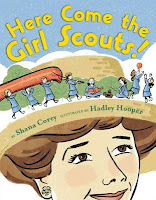
Ordinarily I am opposed to using one book for a male audience and another for a female audience. This year's scout visits represent a rare deviation from my books-have-no-gender book sharing strategy, though. Why? Scaredy Squirrel is always prepared, and the Boy Scout motto is "Be prepared"; and Corey's non-fiction picture book tells the story of the formation of the Girl Scouts organization. Each book speaks to these specific audiences quite perfectly.
Both of these books keep the scout audiences engaged, and I have had more than one den/troop leader ask me how I can keep the attention of a group of squirmy 8-year-olds for 45 minutes from start to finish. What can I say? A good story, the chance to explore a place filled with things to read, watch, and play, and a scavenger hunt around the library can do wonders for engaging kids.
What do you do when scout groups visit your library? Do you lead more specific badge-earning activities, or is it mostly getting them acquainted with the library?

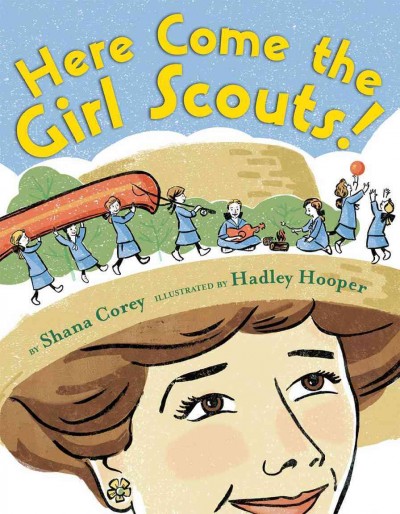
Ordinarily I am opposed to using one book for a male audience and another for a female audience. This year's scout visits represent a rare deviation from my books-have-no-gender book sharing strategy, though. Why? Scaredy Squirrel is always prepared, and the Boy Scout motto is "Be prepared"; and Corey's non-fiction picture book tells the story of the formation of the Girl Scouts organization. Each book speaks to these specific audiences quite perfectly.
Both of these books keep the scout audiences engaged, and I have had more than one den/troop leader ask me how I can keep the attention of a group of squirmy 8-year-olds for 45 minutes from start to finish. What can I say? A good story, the chance to explore a place filled with things to read, watch, and play, and a scavenger hunt around the library can do wonders for engaging kids.
What do you do when scout groups visit your library? Do you lead more specific badge-earning activities, or is it mostly getting them acquainted with the library?
Friday, February 8, 2013
Let's Look at the Pictures: An Outreach Story Time
Have you seen Sarah Bean Thompson's Caldecott Storytimes series? When I saw her latest installment, I decided I had to focus on illustrations in my February outreach. Our local schools are in the midst of Caldecott and Newbery projects right now, so my supplies of Caldecott titles are low, but I grabbed a few other books with beautiful illustrations, all different from one another, and headed to the preschools. Here's how it went.
Opening Song: "Open, Shut Them"
 Story: Chu's Day by Neil Gaiman, illustrated by Adam Rex
Before I began this first story, I introduced our theme for the day: looking closely at the pictures in books to get more from the story. Chu's Day is a shorter story text-wise, but Rex's illustrations add so many layers of richness. I invited children to shout out what they saw in the big picture spreads where Chu is at the library, the diner, and the circus. I included some leading questions to help them see how pictures can fill out details in a story. One example was in the diner spread, where I asked if they could tell who was the chef. We looked for the chef's hat and finally found the whale behind the diner counter. All these small details felt like new discoveries to the kids--discoveries that added to the story.
 Story: The Duckling Gets a Cookie!? by Mo Willems
I shared the cover of this book and asked the kiddos if the pictures looked as detailed as our previous story. Willems's relatively sparse style adds its own flair to his stories, especially the characters of Pigeon and Duckling. The kids love Pigeon's overdramatic responses to everything, and they particularly enjoyed looking at the spreads where Pigeon rattles on about all the things he's asked for but not gotten. And the black steam/rage cloud above Pigeon's head at one point? They loved that and commented on it.
Wiggle Rhyme: "Three Sailors Went to Sea"
Even though I was inviting comments from kids throughout the first two stories, I could tell they were getting wiggly from sitting still. Thus I broke up our session with a wiggle rhyme that Ted from Your Magic Storytime Hat recently reminded me about. We did actions (making waves with our arms for "sea" and putting our hands above our eyes for "see") and repeated the rhyme several times, trying to get faster each time.
 Story: You Will Be My Friend! by Peter Brown
I think Brown's illustration style represented a great middle ground between Rex's rich detail and Willems's expressive minimalism. In this story, Lucy Bear is eager to make a new friend--but she has a rather hard time doing that, what with her distinct personality. One of the beauties of this book, in my opinion, is that the pictures are vital to getting the whole story. That fact invites plenty of talking about what readers/listeners can see in the pictures before I turn the page. My kids were really starting to enjoy talking about what they saw, and they fell into a rhythm of knowing when it was time to quiet down so I could turn the page.
 Story: Max Found Two Sticks by Brian Pinkney
For our last story, we talked about how things in the pictures can hint about what is going to happen next in a story. In this book, Max finds two twigs and decides to make music with them by drumming on all manner of objects. He finds the sticks while his grandfather is washing windows; in the next spread, we see Max drumming on the wash bucket. After his friends show up drinking sodas out of glass bottles, the next spread shows Max drumming on those bottles. By the end of the story, my kids were able to guess what Max would be drumming on next. I also really love sharing this story because it can be interactive--I ask kids to stick out their two pointer fingers to be their own sticks, and they can drum and tap along to the rhythms in the text. Lots of fun all around.
Closing Song: "If You're Happy and You Know It"
I always worry that the kiddos are growing tired of ending our story times with this song, but that's not yet been the case. This time I pulled out the ukulele and asked the children to remember some of the animals we saw in our stories to fill the verses of the songs. My favorite was when they wanted to be pandas like Chu--they decided it was best to pretend to chomp on bamboo if you're happy and you know it and are being a panda.
~~*~~
What are some of your favorite books to share and talk about illustrations?
Opening Song: "Open, Shut Them"
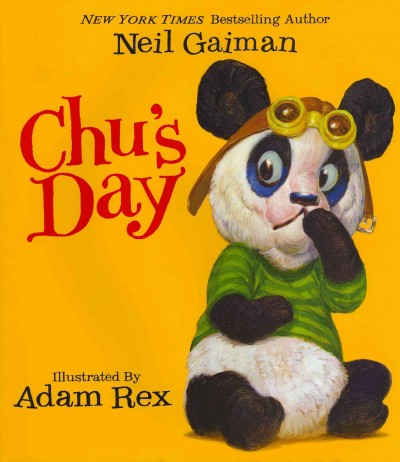 Story: Chu's Day by Neil Gaiman, illustrated by Adam Rex
Before I began this first story, I introduced our theme for the day: looking closely at the pictures in books to get more from the story. Chu's Day is a shorter story text-wise, but Rex's illustrations add so many layers of richness. I invited children to shout out what they saw in the big picture spreads where Chu is at the library, the diner, and the circus. I included some leading questions to help them see how pictures can fill out details in a story. One example was in the diner spread, where I asked if they could tell who was the chef. We looked for the chef's hat and finally found the whale behind the diner counter. All these small details felt like new discoveries to the kids--discoveries that added to the story.
 Story: The Duckling Gets a Cookie!? by Mo Willems
I shared the cover of this book and asked the kiddos if the pictures looked as detailed as our previous story. Willems's relatively sparse style adds its own flair to his stories, especially the characters of Pigeon and Duckling. The kids love Pigeon's overdramatic responses to everything, and they particularly enjoyed looking at the spreads where Pigeon rattles on about all the things he's asked for but not gotten. And the black steam/rage cloud above Pigeon's head at one point? They loved that and commented on it.
Wiggle Rhyme: "Three Sailors Went to Sea"
Even though I was inviting comments from kids throughout the first two stories, I could tell they were getting wiggly from sitting still. Thus I broke up our session with a wiggle rhyme that Ted from Your Magic Storytime Hat recently reminded me about. We did actions (making waves with our arms for "sea" and putting our hands above our eyes for "see") and repeated the rhyme several times, trying to get faster each time.
Three Sailors Went to Sea
Three sailors went to sea, sea, sea
To see what they could see, see, see
But all that they could see, see, see
Was the bottom of the deep blue sea, sea, sea!
 Story: You Will Be My Friend! by Peter Brown
I think Brown's illustration style represented a great middle ground between Rex's rich detail and Willems's expressive minimalism. In this story, Lucy Bear is eager to make a new friend--but she has a rather hard time doing that, what with her distinct personality. One of the beauties of this book, in my opinion, is that the pictures are vital to getting the whole story. That fact invites plenty of talking about what readers/listeners can see in the pictures before I turn the page. My kids were really starting to enjoy talking about what they saw, and they fell into a rhythm of knowing when it was time to quiet down so I could turn the page.
 Story: Max Found Two Sticks by Brian Pinkney
For our last story, we talked about how things in the pictures can hint about what is going to happen next in a story. In this book, Max finds two twigs and decides to make music with them by drumming on all manner of objects. He finds the sticks while his grandfather is washing windows; in the next spread, we see Max drumming on the wash bucket. After his friends show up drinking sodas out of glass bottles, the next spread shows Max drumming on those bottles. By the end of the story, my kids were able to guess what Max would be drumming on next. I also really love sharing this story because it can be interactive--I ask kids to stick out their two pointer fingers to be their own sticks, and they can drum and tap along to the rhythms in the text. Lots of fun all around.
Closing Song: "If You're Happy and You Know It"
I always worry that the kiddos are growing tired of ending our story times with this song, but that's not yet been the case. This time I pulled out the ukulele and asked the children to remember some of the animals we saw in our stories to fill the verses of the songs. My favorite was when they wanted to be pandas like Chu--they decided it was best to pretend to chomp on bamboo if you're happy and you know it and are being a panda.
~~*~~
What are some of your favorite books to share and talk about illustrations?
Wednesday, February 6, 2013
My Plans for World Read Aloud Day 2013
World Read Aloud Day 2013 will take place in one month on Wednesday, March 6. World Read Aloud Day is an event from the folks at LitWorld, and it is a global initiative to draw attention to the prevelance of illiteracy worldwide. Did you know that almost 10% of the world's inhabitants are unable to read? Last year, hundreds of thousands of people celebrated the joys of reading by participating in 65 countries all over the world. My library will be among the many, many sites celebrating literacy this year on March 6.
 I'm planning an all-day celebration of reading at my library to mark World Read Aloud Day. On the half hour of every hour that the library is open (9:30 a.m., 10:30 a.m., and so on through 8:30 p.m.), one of my colleagues or I will announce over the PA system that it is World Read Aloud Day. We'll invite anyone in the library who is interested to join us in Picture Book City, my library's children's area, for a read-aloud story to celebrate literacy. I'm choosing a wide variety of books for my twelve read-alouds: classics, new favorites, non-fiction, poetry, and award-winners will all be represented. We'll share one story every hour, and after the story is over, participants will hear a quick world literacy fact and be asked to write their names on colorful die-cut books. Each cardstock book will be displayed in the entryway of the library. My hope is that we'll have a rainbow of books with names on them in the library entryway to show just how much we support worldwide literacy.
Are you interested in planning your own World Read Aloud Day event? Looking for some tips? Head over to the official website to download activities, an event kit, and the event badge. If you've got Skype capabilities in your facility, you may want to connect with authors and illustrators for your event; author Kate Messner is compiling a list of book folks who are interested in virtual visits to classrooms and libraries, and she'll have full info on her blog later this month. Don't forget to register your event on the LitWorld website, too.
I hope you'll consider sharing the joys of reading and bringing awareness to global literacy by celebrating World Read Aloud Day on March 6!
 I'm planning an all-day celebration of reading at my library to mark World Read Aloud Day. On the half hour of every hour that the library is open (9:30 a.m., 10:30 a.m., and so on through 8:30 p.m.), one of my colleagues or I will announce over the PA system that it is World Read Aloud Day. We'll invite anyone in the library who is interested to join us in Picture Book City, my library's children's area, for a read-aloud story to celebrate literacy. I'm choosing a wide variety of books for my twelve read-alouds: classics, new favorites, non-fiction, poetry, and award-winners will all be represented. We'll share one story every hour, and after the story is over, participants will hear a quick world literacy fact and be asked to write their names on colorful die-cut books. Each cardstock book will be displayed in the entryway of the library. My hope is that we'll have a rainbow of books with names on them in the library entryway to show just how much we support worldwide literacy.
Are you interested in planning your own World Read Aloud Day event? Looking for some tips? Head over to the official website to download activities, an event kit, and the event badge. If you've got Skype capabilities in your facility, you may want to connect with authors and illustrators for your event; author Kate Messner is compiling a list of book folks who are interested in virtual visits to classrooms and libraries, and she'll have full info on her blog later this month. Don't forget to register your event on the LitWorld website, too.
I hope you'll consider sharing the joys of reading and bringing awareness to global literacy by celebrating World Read Aloud Day on March 6!
Monday, February 4, 2013
Books Kids Love, Part I
Anne at so tomorrow and I got to talking on Twitter a few weeks back--she was looking for additional read-alikes for Dork Diaries, and I was offering suggestions for similar series that my kids are enjoying. That conversation turned to how series popularity can vary from library to library, and from there we started wondering what kids love at libraries other than our own. And so this two-part survey was born.
If you'd be so kind, please take a moment to think about what middle grade series are most popular with the kids you serve. There's no need to check circ stats--just name some titles off the top of your head (or look to your hold shelf!). Data collected from this survey will inform the next step in our exploration, with a culmination of series popularity info on our blogs at the end of February. Thanks for sharing what your kids love reading!
If you'd be so kind, please take a moment to think about what middle grade series are most popular with the kids you serve. There's no need to check circ stats--just name some titles off the top of your head (or look to your hold shelf!). Data collected from this survey will inform the next step in our exploration, with a culmination of series popularity info on our blogs at the end of February. Thanks for sharing what your kids love reading!
Friday, February 1, 2013
Angry Birds: A STEAM Program for the Brave
 |
| Our themed projectiles. |
Haha. Oh, no.
 |
| The building supplies. |
I had the best of intentions of making the STEAM elements of this program explicit in my program introduction: I mentioned the engineering inherent in building towers, the science of projectiles, the creativity of making crazy structures. I had the kids' attention for maybe five minutes before their pent-up energy demanded they be allowed to construct and destroy.
 Our 45 minute program featured rapid cycles of tower-building and destruction. I initially encouraged the children to form small groups to create small towers; once they were satisfied with their towers, they worked together to project an Angry Bird at it to knock it down. I then encouraged them to pair with another group to try to build a larger, more structurally sound tower that wouldn't be knocked over by just one projectile. They happily obliged, building structures with solid foundations, but soon the cheers accompanying the destruction overshadowed most of my attempts to provide further guidance. They were having fun, though, so I didn't worry.
Finally, with just eight minutes left in the program, I shouted out the final instructions: children would form a total of three teams, and each team would strive to build the tallest, strongest tower. Then we'd all watch the demolition efforts together. All three groups made massive towers that touched the ceiling tiles--parents put small children on their shoulders to get the final pieces atop the towers. I was impressed by the dedication to the challenge.
The children gathered to watch the destruction of the first tall tower--then cheers. The children moved to the second tall tower to watch its fall--more cheers. But then...
 |
| Mayhem followed. |
The next thing I saw was a room full of maniacally laughing children, pieces of recyclables scattered at their feet, holding bits of cardboard and styrofoam over their heads and tearing them to tiny pieces. Total chaos, yet total joy. So many smiles as families left. So much vacuuming after they were gone.
So I would say, librarian friends, that in my experience an Angry Birds program is not for the faint of heart, especially in the winter. If you aim to offer one, look to those bloggers linked in the intro who seemed to have a calmer time of it. Yet all the mayhem of that evening was worth it, especially when a few kids stopped by the next day to say how much fun it was to build things at the library. It just goes to show that the things you build needn't be permanent for the enjoyment and informal learning to last.
Subscribe to:
Posts (Atom)